Managing finances in Iraq comes with unique challenges.
Businesses often deal with multiple currencies such as IQD and USD, local accounting practices, growing operations across cities, and a rising need for real-time financial control.
That is why traditional methods like Excel and manual bookkeeping are no longer enough.
In this guide, we explore the best accounting software for businesses in Iraq, what to look for, and which solutions actually fit the market.
Key takeaways
- Businesses in Iraq increasingly need accounting systems that support localization, multiple currencies, and connected operations.
- The best accounting software is not only easy to use, but also accurate, security, integrated, and scalable.
- Modern businesses are moving from standalone accounting tools toward ERP-based accounting systems with stronger real-time visibility.
Why businesses in Iraq need modern accounting software
The Iraqi market is digitizing quickly, and businesses are moving away from manual accounting, paper-based records, and disconnected systems.
They are shifting toward automated and real-time financial systems because accounting is no longer just about reporting. It is about control, visibility, and better decisions.
What makes good accounting software in Iraq?
Not all accounting systems are built for the realities of the Iraqi market. A strong system needs to support how local businesses actually work, not just generic accounting tasks.
The most important factors usually include localization, ease of use, real-time financial tracking, integration with operations, and strong security.
Localization
Localization is critical for businesses in Iraq. Good accounting software should support Arabic and Kurdish interfaces, right-to-left layout where needed, multi-currency use such as IQD and USD, and local accounting workflows.
Without that localization, the system often becomes harder to use accurately and consistently.
Ease of use
Accounting software must be simple enough for teams to adopt quickly. A clear interface, minimal training needs, and practical workflows matter a lot.
If the system is too complicated, adoption drops and the business loses value even if the software is technically powerful.
Real-time financial tracking
Modern businesses need live cash flow visibility, instant reporting, and up-to-date balances.
Financial decisions should not depend on outdated spreadsheets or delayed summaries. Real-time data creates stronger control.
Integration with business operations
Accounting should not be isolated from the rest of the business. It should connect with sales, inventory, and purchasing so financial data reflects what is really happening operationally.
This is where many basic accounting tools become limiting. They can track transactions, but they do not connect the business well enough.
Security and reliability
Financial data is sensitive, so a strong system should offer secure data storage, role-based access, and reliable backup processes.
Trust in the accounting system matters because it becomes a core part of business control.
Types of accounting software used in Iraq
In practice, businesses in Iraq often choose among a few broad categories: basic accounting software, regional accounting solutions, and ERP-based accounting systems.
Each category serves different stages of business maturity and different levels of operational complexity.
1. Basic accounting software
Examples include QuickBooks and other simple bookkeeping tools. These systems are often used by small businesses to track income, expenses, and invoices.
They are relatively easy to start with, but they usually offer limited features, weak integration, and poor scalability for businesses that are growing or becoming more operationally complex.
2. Regional accounting solutions
Examples include tools such as Daftra and TallyPrime. These systems are often built with stronger Arabic support and more regionally relevant workflows.
They can offer better localization, but quality, usability, and scalability vary. Some businesses outgrow them when operational depth becomes more important.
3. ERP-based accounting systems
More businesses are moving toward ERP systems with built-in accounting. Examples include Odoo and ERPNext.
These systems integrate accounting with the rest of the business and provide stronger real-time visibility and scalability. However, they can require setup, customization, and may not always match local workflows naturally out of the box.
Bruska ERP: a strong accounting solution for Iraqi businesses
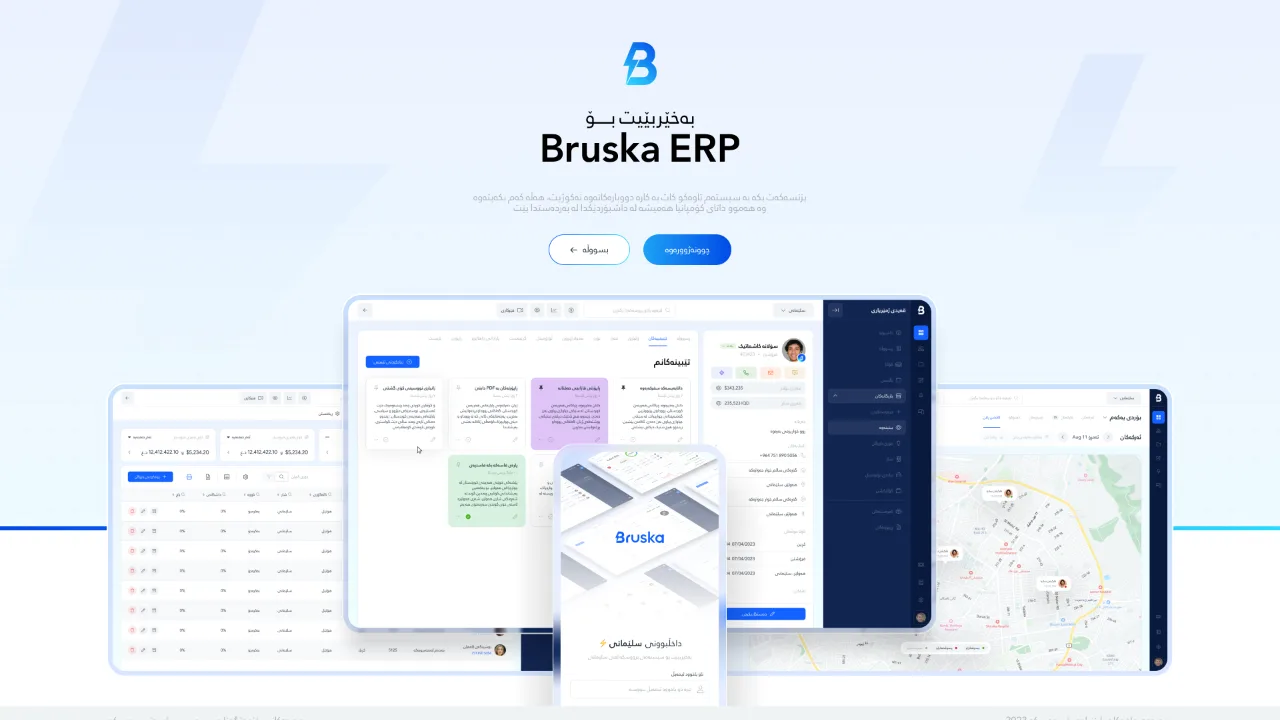
For businesses that want modern, powerful, and localized accounting, Bruska stands out as one of the stronger options because it combines financial control with wider operational integration.
Bruska is designed around Iraqi business realities rather than simply adapting a foreign system after the fact.
Why Bruska ERP is a top choice in Iraq
Bruska supports Kurdish, Arabic, and English, aligns with Iraqi accounting practices, and works with the kinds of workflows businesses in Iraq actually use every day.
It also combines usability, fast onboarding, continuous product updates, cost efficiency, security, and broader business management capabilities beyond accounting alone.
Beyond accounting
Bruska is not just an accounting tool. It connects advanced accounting with sales and CRM, inventory management, purchasing and suppliers, HR, and operations.
That connection matters because financial visibility becomes much stronger when the business runs through one system rather than many disconnected tools.
Real-time financial control
With a connected system, businesses can track cash flow instantly, monitor receivables and payables, generate reports in seconds, and see performance live instead of waiting for manual updates.
That kind of visibility turns accounting from a reporting task into a decision-making advantage.
Works across multiple industries
Although Bruska is especially strong in FMCG and distribution, it also supports retail businesses, trading companies, and service businesses.
That flexibility is valuable for Iraqi businesses that need both local fit and operational depth.
What makes the best accounting software?
The best accounting system is not just the one with the most features. It is the one that delivers accuracy, usability, integration, scalability, and the right fit for your business model.
A system that your team can adopt easily and rely on daily will usually create more value than a more famous but less practical alternative.
Conclusion
Accounting software in Iraq is evolving quickly.
Businesses now have access to global tools, regional solutions, and more modern localized systems.
The key is choosing a system that fits your operations, supports your growth, and gives you real financial control instead of just basic bookkeeping.
 Bruska ERP
Upgrade your accounting system
Book a demo with Bruska ERP and see how your business can move from manual finance management to real-time, connected accounting control.
more than 1,000 companies trust us





































More from Bruska
Continue reading
Accounting
Top 10 Accounting Mistakes Businesses Make (And How to Fix Them)
Many businesses struggle with basic accounting discipline. These common mistakes hurt cash flow, reporting, and decision-making, but each one can be fixed with better systems and routines.
Read article
Accounting
How to Track Accounts Payable and Receivable Properly
Tracking money coming in and going out is essential for healthy cash flow. This guide explains how to manage accounts payable and receivable in a way that supports growth and reduces stress.
Read article
Accounting
What is Accounting Software and Why Your Business Needs It
Accounting software helps businesses track, manage, and understand finances in one system. This guide explains how it works and why it becomes essential as a business grows.
Read article